<img src="https://tags.srv.stackadapt.com/rt?sid=sMb3OHe1xidjJySVfK8yPq" width="1" height="1">

The Homebuilder Marketing Loop

Home builder marketing is a loop. Drive traffic, generate leads, report on what worked, do it again. We show up at every stop, so the work you're already doing turns into leads you can count.


Planning Phase

What stage of marketing strategy planning are you in?

  1. Plan your buyer profile.
  2. Plan your community launch.
  3. Plan your budget.

1. I'm planning my buyer profile.

You have a buyer profile. Maybe it came from the sales team, maybe from a market study, maybe from years of experience about who signs. It's probably close to accurate. But close isn't good enough when your whole marketing strategy stacks on top of it.

Your creative, your channel mix, your messaging, your spend...every decision you make is downstream from the ideal customer profile (ICP).

When it's off, sales tells you the people walking in don't match the ideal buyer. You make channel decisions, but don't know which ones actually reach your best prospects. Leadership wants to know why a community isn't selling and you feel yourself guessing.

With Audience Town, you get a perfect buyer profile, customized to your market. Here's how: our platform pulls real home transaction data from your zip codes, updated every 72 hours, and reveals a buyer profile based on the households actually closing right now. This persona is detailed down to income, home value, family makeup, luxury car ownership, pet ownership, job industry, and credit score. You lay it next to your existing ICP, and where they don't line up is where you adjust.

On the other hand, reaching more of your ICP can unlock everything else.

Customer story: how reaching the right audience improves sales velocity.

EGStolzfus Homes used Audience Town and their ICP match rate went from 2% to 20% in 8 to 10 weeks. Four homes sold shortly after.

Marketing can't work if you're saying the wrong message to the wrong audience.

Build your ICP based on who's actually buying in your market.

2. I'm launching a new community.

A new community is the highest-stakes, lowest-data moment in your year. The budget is big, the timeline is fixed, and you're designing a program for a buyer you haven't actually seen yet. The good news: you don't have to guess. The buyer data for this zip code already exists, and you can use it to build your plan from day one instead of adjusting after the fact.

Our platform shows you who's shopping for homes in the zip codes around your new community before you open the model. You see the income distribution, the home value profile, the life stage of the households actually moving in that market right now.

You build your launch strategy against real buyer data. Then you activate: direct mail to the households likely to move, display and CTV to the in-market buyers, geofencing around the sales centers of the communities you're competing with.

Customer story: why the right community launch plan makes all the difference.

Lennar opened a 40-home community in a California market outside their usual footprint. Using Audience Town data and geofenced targeting around competitor sales centers, they generated 95 qualified leads, more than 2x what they needed, and sold out in 8 months - 4 months ahead of schedule. 

The biggest risk at launch isn't spending too little. It's spending against the wrong buyer.

Build your launch plan around the buyers who'll actually show up.

3. I'm building my marketing budget.

Whether you're setting your annual budget or adjusting mid-year based on performance, you have to allocate and be able to defend it. That's hard to do without knowing what actually drove leads and sales.

Audience Town shows you what's working across communities, campaigns, and channels, so you can confidently invest your marketing budget. You'll identify which channels and keywords are actually delivering the right buyers, even before the form fill. CRM integration means you can track the full path-to-purchase. And with Ads, you can focus your budget on likely home movers while excluding agents, bots, and recent buyers.

Then you allocate or reallocate with confidence, backed by data instead of last year's assumptions.

Make every dollar work harder.

Activation Phase

How will you reach and re-engage potential home buyers?

  • Reach more traffic.
  • Convert more leads.
  • Nurture existing leads.

4. I need more qualified traffic.

If you need more traffic, you know how to get it: more content, more advertising, more posts. And with our ad solutions built for home builders, we can help you show up where it matters. 

Our ad solutions, combined with Foundation, let you see the demographic, financial, and lifestyle profiles of visitors from every channel. That means you can invest more budget on channels that attracting buyers that can afford your homes.

Real customer story: how one builder generated 60% more traffic on a new channel.

One home builder, one new CTV campaign, one month: 60% more website traffic year-over-year and 24% more key site events. The takeaway? Be where your home buyers are.

Build a flywheel of better performance, from first click to close.

5. I need more leads.

If you need leads, you have to start by looking at your conversion rate (what percentage of visitors fill out a form). 

If your conversion rate is solid (above 10-15% on landing pages, and above 2-3% on your website), your job is to generate more qualified traffic. 

But if it's too low (under 15% for a landing page, or 2% for general site traffic), you need to start investigating. 

Lead conversion problems can be traffic quality problems in disguise. Are you reaching people who are actually in-market for a home? What about people who can actually buy your properties? Most home builders haven't been able to answer that question. Google Analytics is limited. But Audience Town's Foundation platform shows you who's visiting your site, with demographic and financial profiles you can't get anywhere else. We'll also show you what they do after they hit your site. You'll know whether the issue is who you're reaching or what's happening after they arrive - and you'll have the data to back you up.

You don't need more marketing. You need marketing that reaches and converts the people who are actually buying.

6. I'm working my existing leads.

You have a list. Tours from three months ago. Form fills from six. Names your sales team called once and moved on from. Most of them are still in your CRM, and most of them have gone quiet.

But home buyers don't shop in a straight line. Rate anxiety, life events, "let's revisit in the spring." Some of those leads are still shopping. Some already bought somewhere else. Right now, you have no way to tell the difference, and every generic nurture touch costs money you're spending on people who aren't coming back.

Audience Town fixes that. We connect to your CRM and sort your list into two groups: still in-market, and already bought somewhere else. Then we help you drill into the audience quality of the still-in-market group so you can see which leads match your best buyers and prioritize them. From there, we activate through the channels home buyers actually use. Direct mail and retargeting to convert the ones moving toward a decision. CTV, streaming audio, display, and Meta to stay in front of the ones still thinking. Not another email they'll delete. A smart mini funnel that meets each lead where they are.

Two real customer stories: how smarter retargeting engages you best leads better.

One builder who launched a targeted direct mail to re-engage households saw a cost per lead around $14, against a $100 industry benchmark for cold prospecting. 

Another leading builder, Maronda Homes, tested Audience Town's retargeting against standard Meta retargeting and saw 73% more engaged sessions and 220% more key site events, with no change in spend. 

With smart retargeting, you're not starting from scratch. You're working a list you already paid to build.

Your existing leads are your next quarter's customers. Are you working them like it?

Evaluation Phase

How will you know what's working?

  • Know if your leads are good.
  • Show if ads are working.
  • Prove what's working.

7. I need to know if my leads are good.

Sales is pushing on leads. There aren't enough, or maybe they aren't good quality. And while you want to be helpful, you know there's usually more to the story.

The last thing you need is "another report I don't know what to do with." What you need is real consumer intelligence about your leads. You need something you can take to sales and say, "here's what's really going on. How can we work together?"

That's what Foundation delivers. You'll see the full picture of who's coming in, who's engaging, and who's actually ready to buy. Sales gets proof instead of theories. You get a shared fact pattern to plan from, so you're aligning, not arguing.

"This is amazing to have this data and be able to go in and analyze it, then pivot and work your marketing strategy around the actual buyers."

— VP of Marketing, regional home builder

Prove lead quality, and address challenges as a team.


8. I need to show if ads are working.

You're spending money on ads. How do you know they're working?

Honestly, most home builders don't.

Audience Town helps you track ad spend to home sale, so you can prove the ROAS of every campaign. Foundation follows every campaign from ad impression to site visit to lead to contract, so you see what actually moved buyers, not just what your vendor reports say.

And when you run ads through us - like direct mail, display, CTV, geofencing, Meta retargeting - performance reporting is more integrated, so you're not stitching reports together to guess at what worked.

Real customer story: how one builder generated 4 qualified calls in 3 weeks with CTV.

One leading home builder tested CTV ads, and received 4 qualified phone calls (and more form fills) after just 2-3 weeks.

With Audience Town, you get an easy button for ads and insights about their performance.

Get clarity on your ad performance.

9. I need to prove what's driving leads and sales.

Proof is the single thing that separates good marketing from good marketing that gets credit. You know the work is happening. You can see the leads coming in and the channels running. But when leadership or sales asks what's working, the answer has to be specific, backed by data, and clear enough for a non-marketer to act on. That's harder than it sounds when your data lives in five places and none of them agree.

This shows up in two moments. The weekly or monthly community review, where sales and leadership ask what's happening with a specific community and why. And the quarterly or executive presentation, where the question gets bigger and the stakes rise. Both moments require the same thing: a connected view of what marketing delivered, translated into language the room can understand.

Audience Town gives you that proof, already connected. Foundation tracks every channel, every campaign, every lead, and every closing in one platform, across every community you run. Not just impressions and form fills. The actual path a buyer walks from first ad impression to contract. You walk into the reporting call with one picture of the quarter, not four vendor reports that almost agree. And over time, the data stops being something you reach for when the review looms. It becomes something you keep in your pocket, weaving into conversations with leadership between reviews.

"It gives me my biggest opportunity to go fix, right?"
— IT director, regional home builder, seeing the Audience Town benchmark chart for the first time

Chances are, you don't have a marketing problem. You have a reporting problem.


Improve Phase

How will you optimize your marketing?

  • Improve channel performance.
  • Improve community performance.

10. I have a channel that isn't performing.

What do you do when one of your channels isn't performing how it should?

Most marketers try to evaluate ROI first, but there are two problems with that approach. First, it's hard to track ROI when your data is spread across reports and disconnected from actual sales. And second, it doesn't give you any insight into why the channel isn't working.

To answer the big question ("Should I reduce budget, shift strategy, or cut the channel altogether?") you need insights that address the core marketing challenge at play: can this channel get your brand in front of the right people, with the right message?

Audience Town answers both. Foundation shows you who each channel is reaching, what they care about, and how they compare to the buyers in your market. From there you can adjust targeting, rework creative, or move the budget with confidence. And if you do decide to cut a channel, Audience Town helps you reallocate to a new one with precision, targeting the right audiences through our activation solutions: direct mail, display, CTV, geofencing, streaming audio, and Meta retargeting.

Customer story: how aligning ad creative to the consumer demographics improved campaign performance.

One home builder noticed their paid social was lagging their other channels. They looked at who the ads were reaching and found 60% of their community site visitors owned dogs. The community had a mudroom dog wash option the creative hadn't featured. They updated the imagery. Traffic lifted and option sales increased within two weeks. Same channel. Same spend. Different creative.

Make the right call on every channel.

11. I have a community that isn't performing.

Not every community hits its numbers. And when one is lagging, the real question isn't whose fault it is. It's how to get it moving again. It's harder to do that when you're working from a "best guess."

Audience Town gives you a clear picture. Foundation shows you who's visiting that community, how they compare to the buyers actually closing homes in the market, and where the gap lives. Targeting, pricing, creative, or a shift in the local market...you see the cause, not just the symptom. From there, the path forward is specific: adjust what needs adjusting, leave alone what's working, and track the change.
Real customer story: How clarity drives community sales.

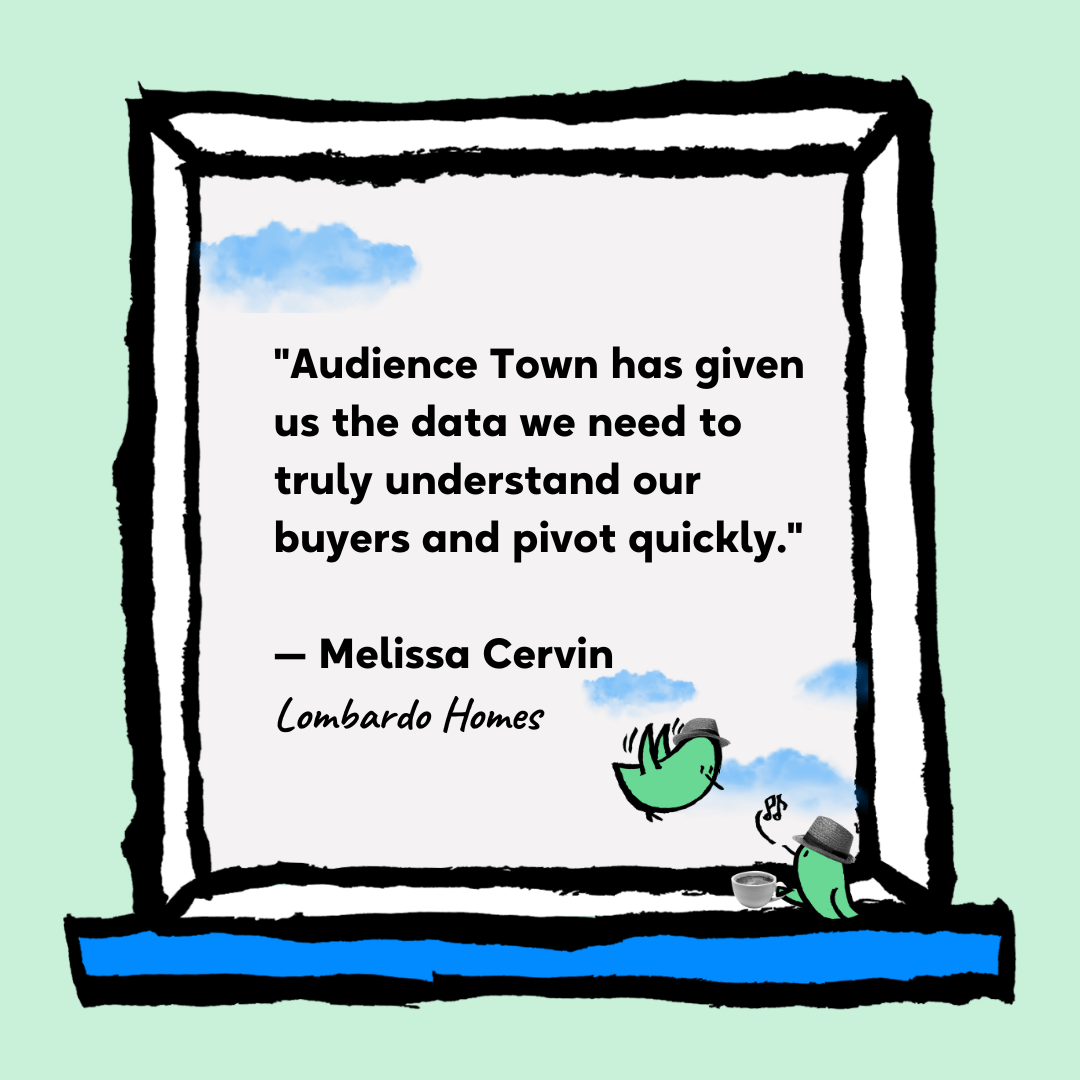
Melissa Cervin, VP of Marketing at Lombardo Homes, had a community with steady traffic but sluggish sales. Audience Town showed her the mismatch: the financial capacity of visitors didn't match the inventory's price point. She repositioned the community to attract out-of-town buyers looking for a destination home, and drove a measurable increase in homes under contract.

Get the community moving again.

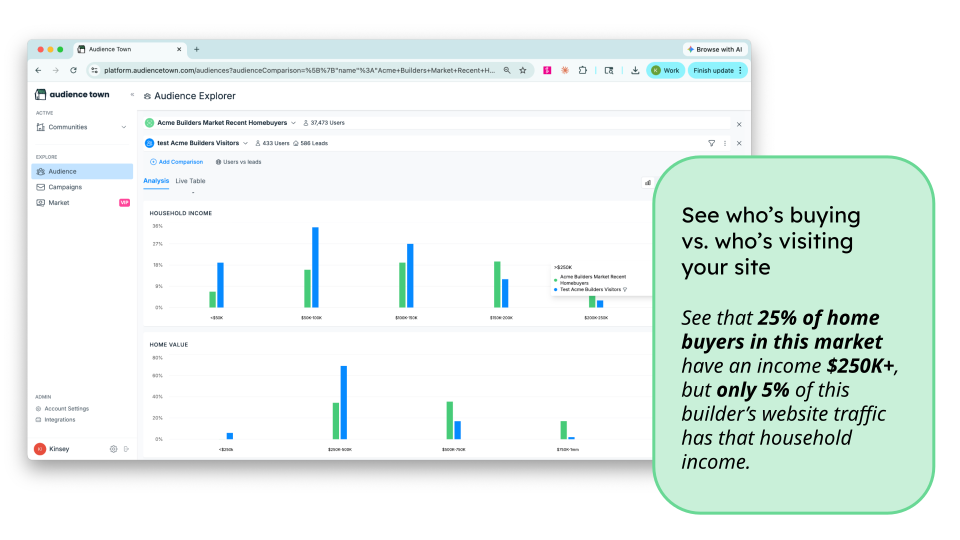
This is the only marketing report that shows you what's happening at your community, in your market. Overlay your website visitors on the actual home buyers in your zip codes. The gaps show instantly.

In this demo market, 25% of recent home buyers earn $250K+. Only 5% of visitors to this community's website do. That's a 5x gap between who's shopping and who's showing up, and it's the kind of insight that changes every conversation you have about targeting, creative, and spend.

"Is marketing working?" is a good question. But there's a better one: "Are we reaching the people actually buying in our market?"

Now you can answer it.

Why Audience Town?

We offer 3 things you can't get anywhere else.

2026 New Website Images (12)

Frequently asked questions

Here are some common questions and their answers.
What is homebuilder marketing?

Home builder marketing is the full set of activities a home builder uses to attract, engage, and convert new home buyers. It spans audience research, community-level advertising, website analytics, lead generation, and sales attribution across different builder types, like master-planned communities, scattered-lot construction, traditional new construction, and multifamily developments.

Unlike general real estate marketing, home builder marketing sells the community, not just the home, and it relies on richer data to reach the specific audiences actively shopping for new homes.

How is homebuilder marketing different from real estate marketing?

Home builder marketing focuses on new construction communities, where marketers sell the lifestyle, location, and amenities of a community rather than an individual home at a price point.

Real estate marketing tends to center on individual listings and agent branding. Home builders also have access to richer data and need audience, analytics, and attribution tools built specifically for new construction.

How do home builders get more qualified leads?

Home builders get more qualified leads by targeting the households actually in the market to buy, not just the traffic coming to their websites. This means using real home mover data, not outdated personas, to identify in-market buyers and reach them through the channels they actually use, such as CTV, display, direct mail, and paid social.

Audience Town does this end to end, from identifying real buyers to activating and tracking the campaigns that reach them.

What data do home builders need to target home buyers effectively?

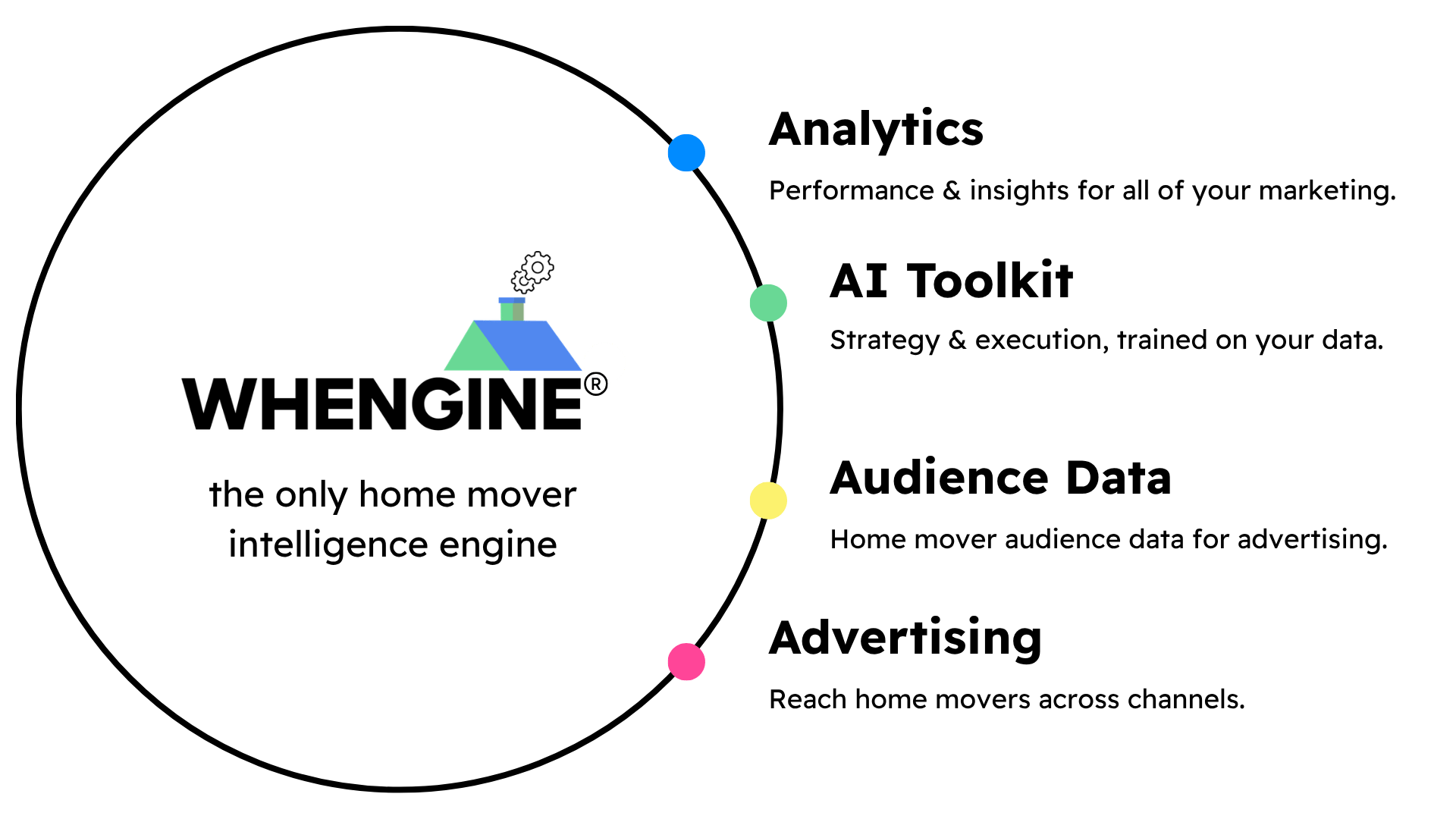
Home builders need real-time home mover data, not just census data or static personas. Effective targeting requires knowing who is actually moving, what they can afford, where they're coming from, and what they care about in a home. Audience Town's Whengine processes 300 billion data events daily to deliver this kind of current, specific buyer intelligence, purpose-built for the home building industry.

How do home builders track marketing ROI across channels?

Home builders track marketing ROI most effectively when every campaign, channel, and lead source connects back to actual home sales. The challenge is that most builders use separate tools for analytics, advertising, email, and CRM, which leaves ROI scattered and hard to defend. Audience Town's Foundation platform tracks the full path from ad impression to closed home, giving builders one connected view of what their marketing actually delivered.

What if I already have an agency or marketing tool?

Audience Town is built to work with what you already have. If you work with an agency, we partner with them to provide the data, audience intelligence, and performance tracking that make their campaigns more effective. If you use other tools for email, CRM, or paid search, we integrate with many of them to build a unified view of your marketing. You don't have to replace anything to get value from Audience Town.

What is Audience Town?

Audience Town is the creator of the Whengine, the #1 consumer data superset of people and property in the country. This data engine powers everything we provide.

Our analytics and advertising platform purpose-built for home builders, including master-planned, scattered-lot, traditional new construction, and multifamily developers. It combines the largest home mover data set in the country with advertising activation across CTV, display, direct mail, geofencing, streaming audio, and Meta, plus full-funnel analytics that track every campaign from ad impression to closed home.

Home builder marketers use Audience Town to reach real buyers, prove what's working, and grow with confidence.

How much does Audience Town cost?

Audience Town is affordable.

The platform is priced to be accessible for mid-sized and growing home builders, not just national brands. Platform subscribers pay one monthly price that covers unlimited users and all of your communities. Pricing typically works out to 1-3% of a community's marketing budget, and it makes the rest of that budget work harder by pointing it at the right audiences. 

Advertising services are also affordable, and vary by channel.

How long does it take to see marketing results with Audience Town?

Most Audience Town customers see their first actionable insights within 30 days, after the website pixel is installed and data begins flowing. Campaign performance improvements typically show up within 8 to 10 weeks as targeting is refined and creative is optimized against real buyer data. The platform is designed for fast onboarding, with a dedicated CSM guiding each builder through the first weeks.

You've seen the loop. Now run it with us.

Every stop you just walked through is a stop we can activate. Start with the one where you feel the most pressure, or start where you want to grow. We'll help you build from there.
Your privacy choices