.png?width=250&height=27&name=AT%20-%20LOGO%20-%20BLACK%20-With%20White%20House%20(2).png "audience-town")
.png?upscale=true&upscale=true)
At the International Builders' Show in Orlando, I had the pleasure of discussing a topic that keeps coming up: how to work with your tech vendors to get what you actually need.
The question I hear most often from builders heading into a new year is some version of: "What technology should we invest in that will really move the needle?"
It's a reasonable question. But after years of watching builders chase tools and platforms, I've come to believe the answer has less to do with specific products and more to do with a framework for thinking about what you actually need.
That framework comes down to three types of home builder marketing technology. More on those in a minute.
First, the forecast.
Builder confidence dipped again. The January NAHB/Wells Fargo Housing Market Index came in at 37, down from 39 in December and 47 a year ago.
Inventory is growing. Active listings rose 12.1% year-over-year in December. That sounds like progress for buyers, until you realize we're still 12.5% below 2017-2019 inventory levels. Homes are sitting longer. Days on market have crept up. Price cuts and incentives are more common.
We heard this at IBS constantly: home buyers are reluctant. Hesitant. Deliberate. Whatever word you use, the message is the same: sales are slower.
The gap between browsers and buyers keeps widening. And most builders are still measuring success by indicators that don't tell them who is actually going to close..png?upscale=true&upscale=true&width=558&name=New%20Ed-Itorial%20Graphics%20(5).png)
70,000 builders = wildly different tech stacks
We covered the builder tech landscape a few months ago: 70,000+ home builders in the US, maybe 2,000 active, about 20 with Fortune 500-style tech stacks, and everybody else picking vendors carefully while focusing on building homes.
What I want to dig into this month is the follow-up question. You know you need technology. Unless you’re one of a couple dozen builders, you know you are not going to build a custom stack. So how do you decide where to invest, and how do you get the most out of the vendors you choose?
It starts with understanding what you actually need. And in my experience, what builders need falls into three types of tech needs.
The 3 types of marketing tech needs
When we talk to builders about technology investments for marketing and sales, the needs fall into three categories. Most builders have the first two covered. Almost everyone is missing the third.
Type 1: ID your leads
This is your CRM and your first-party data. Know who is in your pipeline, where they are in the journey, what actions they have taken.
Most builders have a CRM. Many are under-using it.
Before buying anything new, ask what you are getting out of what you already have. Tags, segmentation, lifecycle stages. These features exist in your CRM right now. The question is whether anyone is deploying them.
Your CRM has first-party data you are likely sitting on. Leads, site visitors, email opens. That data is valuable, but only if someone is actually looking at it and acting on it.
Type 2: Activate across channels
These are the tools that let you get in front of prospects wherever they spend time.
Whether you are running this in-house or handing it off to an agency, you probably have this covered too.
What worked in 2024 may not work in 2026. AI is reshaping how people search. Social media is isolating segments into algorithmically-driven content. Streaming dominates video consumption. The channels that drive qualified traffic today might not be the same ones six months from now.
More channels is probably not what you need. Rather, you need to stay close to the data so you can focus on the channels that actually drive qualified traffic.
Type 3: Get more of the right people into 1 and 2
This is the gap.
In previous editions, we have talked about Wanamaker Waste (i.e. "Half the money I spend on advertising is wasted. The trouble is I don't know which half.")
Mainstream consumer brands have chipped that waste down to maybe 20% through better attribution, data, and targeting. For the average home builder, that wasted spend is still sitting around 50%.
Half your marketing budget is reaching people who will never visit a sales center.
And when sales slow, the default response is always the same: spend more.
But spending more on the wrong audience just accelerates the waste.
In 2026, the tools to separate serious buyers from browsers are more accessible and affordable than they have ever been. Traffic analytics, demographic matching, behavioral signals. This is where your investment should go.
.png?upscale=true&upscale=true&width=558&name=New%20Ed-Itorial%20Graphics%20(6).png)
Why type 3 matters most right now
A quick recap of carrying costs: when a completed home sits unsold, the carrying costs (taxes, insurance, maintenance, lending costs) add up to $2,000 to $3,000 per month. That is $24,000 to $36,000 annually per unsold unit.
We’ve also talked about why builders spend more on marketing when sales slow, not less. In most industries, soft demand means cutting the budget. In home building, you cannot turn off a three-year land development pipeline. When inventory piles up, aggressive advertising is the rational move because the cost of holding is worse than the cost of spending.
So home builders are going to spend. The question is whether the money goes to the right people.
If you can see who your marketing is reaching, and whether those people match your actual buyer profile, you make smarter decisions in real time. You get more return for every dollar. And instead of guessing which half of your budget is wasted, you start closing the gap.
That is why precision is where the leverage is in 2026.
.png?upscale=true&upscale=true&width=598&name=Data%20Story%20(2).png)
What this looks like in practice
We have a customer in Eastern Pennsylvania. They had a community near a major corporate campus. Prime location for the professional workforce right next door.
They hired a third-party marketing agency to drive traffic. For a year, nothing sold.
When they turned on Audience Town's traffic analytics, the problem was obvious: less than 2% of their website visitors matched their ideal customer profile. They were getting traffic. Just not the right traffic.
They brought their advertising in-house and used demographic data to shift their targeting toward buyers who actually fit the community.
Within a month, they sold four homes.
They already had the CRM. They already had the channels. What they did not have was visibility into whether the people clicking their ads were the people who would actually show up and close.
Once they could see the gap, the fix was straightforward. That is 3.
.png?upscale=true&upscale=true&width=558&name=Blog%20Images%20-%20Audience%20Town%20(12).png)
Before you buy anything: define the problem
This is the core of what I discussed at IBS. Most builders jump straight to "what tool should I buy?" The better question is: "What problem am I solving?"
Four questions to ask before evaluating any technology:
- What does the business actually need? Not what sounds interesting. What is the specific pain point?
- How do we do this today? There might already be a process, even if it is manual and slow.
- Does a solution already exist that we are not using? Your CRM probably has features you have never activated. Your analytics platform might already capture data you have never looked at.
- Is this problem solvable with current tools? Data gaps that were unknowable five years ago are knowable today. Customer information, lead attribution, traffic quality. Solutions exist. The thing you don't know is probably knowable. You just have to find it.
What problems typically get solved through new technology: saving money on research and reducing waste. Automating processes that took a week to now happen in real time. Measuring what is working instead of guessing.
If the answer to those four questions points you toward a gap, then you are in a position to have a productive conversation with a vendor.
-1.jpeg?upscale=true&upscale=true&width=558&name=IMG_1537%20(1)-1.jpeg)
Why collaboration beats customization
My thesis for the IBS session comes down to this: Mid-size builders who collaborate with their vendors get better results than large builders who build custom. But only if they know how to work the relationship.
The top 20 builders have software engineering teams. They build custom integrations or demand enterprise-grade infrastructure that only the biggest vendors can provide. That works for them.
You don't have that. But you also don't need it.
What you have is agility and access to vendors who specialize in your exact problems. Here is what that collaboration looks like:
- You share the problem in detail. What the business needs, how you do it today, what is inadequate about current tools.
- The vendor determines if they can solve it. And critically, whether they can solve it for you and other clients. That is how the economics work. They need multiple buyers to justify the build.
- Together you scope what is feasible and when. Result: you get close to what you need. The vendor gets innovation informed by real-world problems.
We have seen this play out. One of our clients needed to understand consumer demographics in a given market before making land decisions. The existing approach cost $200,000 and took weeks.
Working collaboratively, we built a solution that is faster, cheaper, and updates in real time. That happened because the client articulated the problem clearly and we could build something that served multiple customers.
For builders without in-house engineering teams, vendors are an extension of your team. Treat them that way. The payoff is significant.
-thumb.jpeg?upsize=true&t=1772463152382&D%20Department(1)-thumb.jpeg&D%20Department(1)-thumb.jpeg?upsize=true&t=1772463152382&D%20Department(1)-thumb.jpeg&D%20Department(1)-thumb.jpeg?upsize=true&t=1772463152382&D%20Department(1)-thumb.jpeg&D%20Department(1)-thumb.jpeg?upsize=true&t=1772463152382&D%20Department(1)-thumb.jpeg&width=558&composeType=play_button&overlayColor=%232f4254&overlayScale=0.3&name=Tech%20Companies%20are%20Your%20Outsourced%20R%26D%20Department(1)-thumb.jpeg?upsize=true&t=1772463152382&D%20Department(1)-thumb.jpeg&D%20Department(1)-thumb.jpeg?upsize=true&t=1772463152382&D%20Department(1)-thumb.jpeg&D%20Department(1)-thumb.jpeg?upsize=true&t=1772463152382&D%20Department(1)-thumb.jpeg&D%20Department(1)-thumb.jpeg?upsize=true&t=1772463152382&D%20Department(1)-thumb.jpeg)
Bottom Line
Three type, one gap. You have 1 and 2. Type 3, getting the right people into your funnel in the first place, is the 2026 opportunity.
The math supports the spend. We have covered the carrying cost calculation and why builders spend more when sales slow. At $2,000+ per month per unsold home, marketing is not an expense. It is insurance. The question is whether you will know where the money went.
The proof is in the data. One of our clients sold four homes in a month after a year of no sales. They did not buy a new CRM. They did not add more channels. They got visibility into who their marketing was actually reaching. That is Bucket 3.
If you are investing in anything this year, invest in finding people who will actually close. You are going to spend the money anyway.
Audience Town helps you know who's moving in your market, where, and why.
How Audience Town helps
NAHB reports that 37–40% of builders are cutting prices and roughly two‑thirds are using sales incentives, with average cuts of about 5% off list price.
As we discussed last month when inventory piles up, the math favors aggressive moves.
Increasing advertising is another one.
Even with Wanamaker Waste, the return on ad spend beats the alternative of holding unsold homes or the drastic move of taking a loss on a property. A $10,000 monthly ad budget looks a lot more reasonable when the carrying costs of not selling are eating into your margins.
We are already seeing this.
Builders are increasing paid marketing spend to generate as many leads as possible from fewer prospects. It is the opposite of what most industries do when sales slow down, but it makes sense when you understand the economics of holding inventory.
But spending more is different from spending smarter.
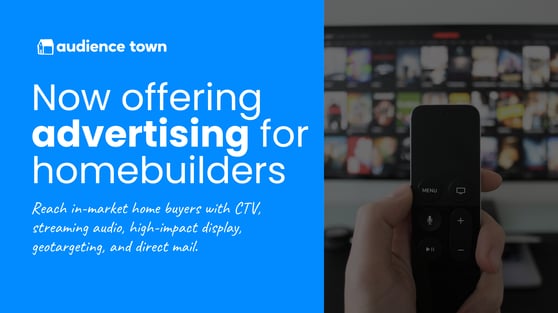
That's why Audience Town now offers precision advertising for home builders.
You can reach your in-market home buyers across digital and physical channels, like streaming audio and direct mail. The results are compelling.
Schedule a demo to see how we can help.
