.png?width=250&height=27&name=AT%20-%20LOGO%20-%20BLACK%20-With%20White%20House%20(2).png "audience-town")
.png)
There are thousands of ways to slice an audience. Most of them start with the wrong signal.
Audience Town starts with the most economically significant consumer moment in a person's life: the home move. The result is a targeting foundation that the rest of the industry isn't structured to replicate.
Here's why.
The Home Move Is the Epicenter of Life Events
A home move isn't a single purchase decision. It's a catalyst.
Around 20-30 million Americans move every year. When they do, they collectively spend approximately $200 billion making their new house a home. But the financial footprint of a move extends far beyond furniture and appliances. A move happens at the intersection of everything else: relationship changes, career transitions, new households, growing families. It's the big bang of consumer life events.
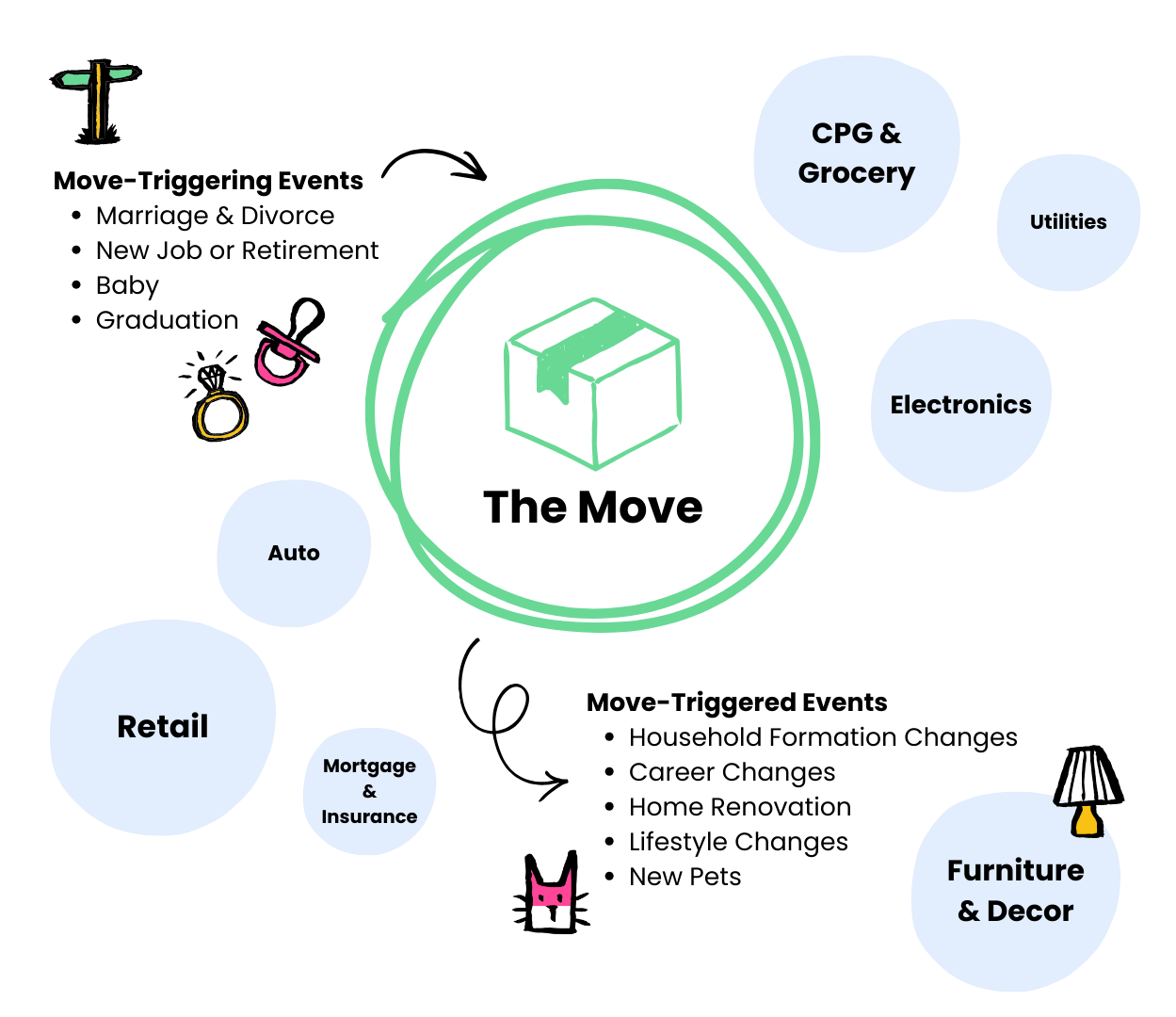
When someone moves, their brand loyalties reset. They switch grocery stores, insurance providers, and internet providers. They buy a new mattress, a new car, and new electronics. They renovate. They landscape. They stock a kitchen from scratch. The categories affected by a single move span nearly every corner of the consumer economy.
Movers are in market for all of it at once, during a compressed window when they're more open to new brands than at almost any other point in their adult lives. That's why the home move is the right signal to build on. Not because it's adjacent to a few high-value categories, but because it unlocks purchasing across all of them simultaneously.
Why Home Movers Matter
20-30M Americans move annually and over 65M are shopping at any given time. Moving is the single largest shift in consumer behavior and brand loyalty. When people move, they spend tens of thousands of dollars on goods and services to build their new life.
Home movers spend $200B annually before, during, and after the move.
This is a critical moment for advertisers looking to attract and convert consumers at a peak moment of spending and interest.

The Mover Multiplier
Most audience signals unlock one category. A home mover signal unlocks all of them at once.
When someone moves, they don't just need a mattress. They need a mattress, a couch, a refrigerator, a new insurance policy, a new internet provider, a new grocery store, and often a new car. New addresses require ground-up replenishment of CPG goods, home essentials, and durable retail goods across every room, every service account, and every recurring purchase in the household.
This is the mover multiplier: a single life event signal that increases ad relevance and conversion probability simultaneously across dozens of categories. It works because the context is real. A mover seeing a furniture ad isn't browsing casually. They have an empty living room. That's not interest-based targeting. That's timing.
The multiplier also works because brand loyalty is uniquely fragile during a move. Movers are significantly more likely to switch providers for insurance, internet, and utilities, and to try new CPG brands as they rebuild shopping routines in a new area. The window is compressed and the openness is real. Brands that reach movers during this period don't just win a transaction. They win the relationship at the moment it's being formed.
The Home Journey: Six Stages, 24 Months
What makes Audience Town's approach distinctive isn't just that we focus on movers. It's that we map the entire Home Journey: a 24-month timeline that begins well before a move happens and extends long after the boxes are unpacked.
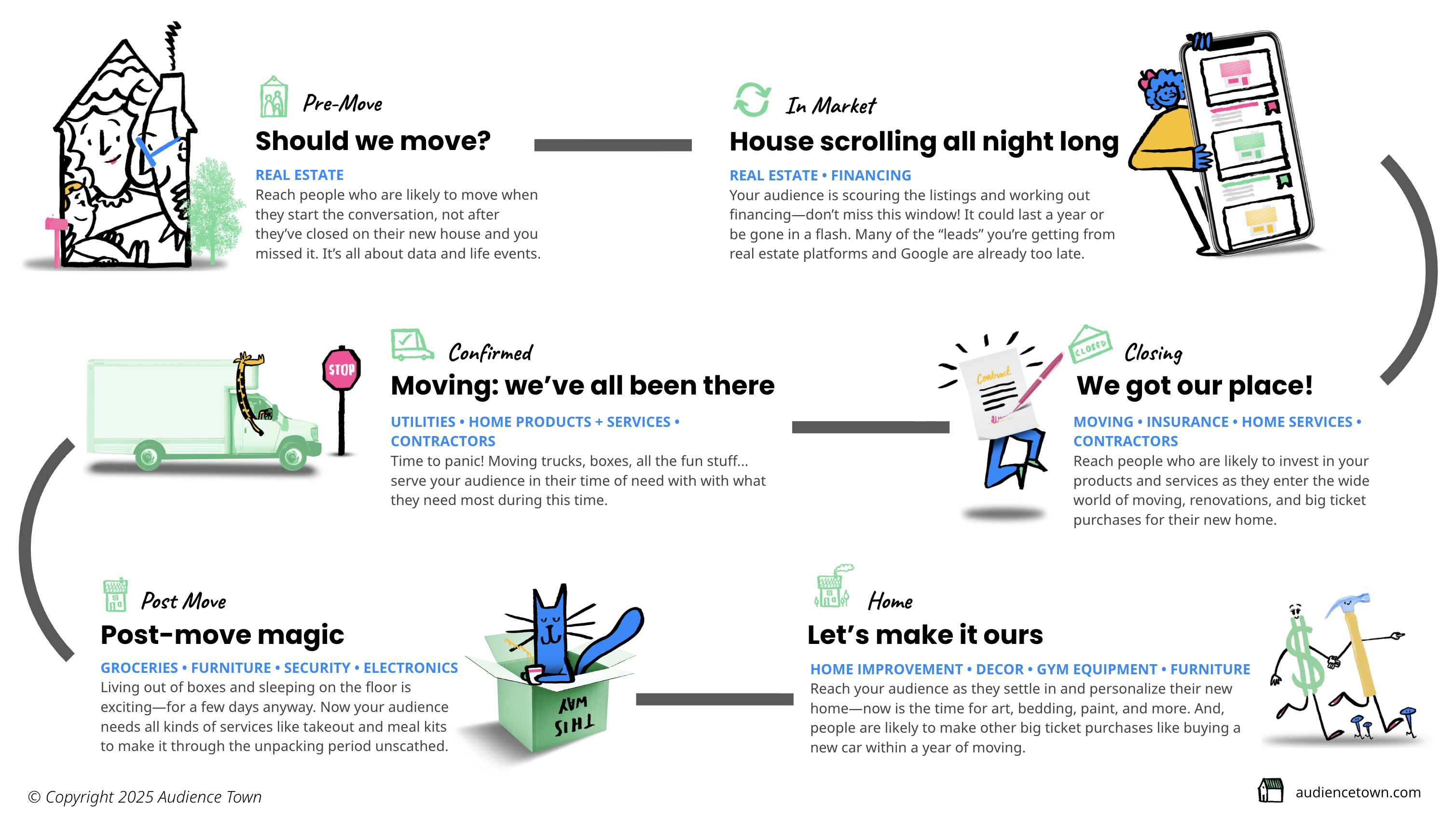
Each stage has its own consumer behavior patterns, purchasing triggers, and relevant advertising categories.
Stage 1: Pre-Move ("Should we move?")
Relevant categories: Real Estate
This is when intent first forms. People start weighing the decision to move, researching what's possible, and making the life choices that set a relocation in motion. Reaching consumers here, before they're actively in market, is the earliest and most valuable targeting window in the entire Home Journey.
Stage 2: In Market ("House scrolling all night long")
Relevant categories: Real Estate, Financing
Consumers are actively browsing listings, comparing neighborhoods, and working out financing. This window can last a year or disappear in a flash. Many of the leads brands capture from real estate platforms and search are already too late. Audience Town identifies these consumers while they're still deciding.
Stage 3: Confirmed ("Moving: we've all been there")
Relevant categories: Utilities, Home Products and Services, Contractors
The decision is made. Moving trucks, boxes, logistics. Consumers in this stage need services urgently and are highly responsive to relevant advertising.
Stage 4: Closing ("We got our place!")
Relevant categories: Moving, Insurance, Home Services, Contractors
Consumers are entering the wide world of moving, renovation planning, and big-ticket purchases for their new home. Brand loyalty is at its most fluid. This is one of the highest-value targeting windows for insurance, home services, and financial products.
Stage 5: Post-Move ("Post-move magic")
Relevant categories: Groceries, Furniture, Security, Electronics
Living out of boxes, establishing new routines, and making immediate household purchases. New shopping habits form here that can last years.
Stage 6: Settled ("Let's make it ours")
Relevant categories: Home Improvement, Decor, Gym Equipment, Furniture, Auto
Consumers are personalizing their new home and making additional big-ticket purchases, including, statistically, a new vehicle within the first year of a move.
Audience Town is the only company 100% focused on mapping and segmenting all six stages of this journey. That singular focus is what makes the data deeper, more current, and more precise than anything built as a secondary product by a general-purpose audience platform.
The Lock-In Effect: Reaching the Stayers
Not every high-value home audience is moving. Some of the best renovation and home improvement prospects are the people who have decided to stay put.
Homeowners with low fixed-rate mortgages are significantly less likely to move than they would be in a normal rate environment. But they still have equity, aging homes, and life events driving real spending. They are remodeling kitchens, replacing HVAC systems, adding solar, refinishing floors, and taking out HELOCs to fund it all. They just aren't changing their address.
Audience Town's Lock-In Effect segment identifies these households: confirmed homeowners with home equity, older properties, and behavioral signals indicating renovation intent. It is one of the most differentiated segments in the catalog because it doesn't exist anywhere else. No USPS-seeded data captures it. No credit bureau model predicts it. It requires the combination of property-level deterministic data and observed behavioral signals that only the Whengine™ can produce.
For home improvement, flooring, windows, HVAC, solar, and HELOC brands, this is the audience that standard mover targeting misses entirely.
The Data Stack: Observed, Deterministic, and Probabilistic
Audience data is only as good as the signals it's built on. Most platforms rely primarily on probabilistic modeling: using statistical inference to predict who might be in a given audience based on loosely related behavioral signals. Probabilistic modeling isn't inherently flawed, but when the foundation is thin or tangential, the model compounds the noise rather than the signal.
Audience Town uses all three data types, and the foundation matters.
Observed Data
Observed data is behavioral evidence captured in real time. It's what the Whengine™ registers when someone starts moving through the Home Journey: lifestyle shifts, geographic behavioral changes, and purchase patterns that signal a move is underway. These are witnessed behaviors, not inferred ones. The Whengine™ processes over 300 billion digital events daily across 280 million US adults, tracking 4,000 consumer attributes per person to identify where each household sits on the Home Journey timeline.
Deterministic Data
Deterministic data is recorded fact. Title transfers. Parcel-level ownership changes. Confirmed address change records sourced from over 2,000 tax assessors and municipalities nationwide, cross-referenced against our adult graph. No modeling required because the event has already occurred and been officially recorded. This is the backbone of Audience Town's post-move segments.
Probabilistic Modeling
Probabilistic modeling extends reach by identifying households that share behavioral and demographic characteristics with confirmed movers: people who are likely in the pre-move window but haven't yet generated a deterministic signal. The difference between Audience Town's probabilistic modeling and the industry baseline is what it's built on. Because our models are trained on verified observed behavior and confirmed life events rather than generic digital browsing patterns, even our predictive segments are grounded in real Home Journey signals from the start.
How Audience Town Builds Audiences
The process follows five steps:
-
Collection (mostly first-party data, with some second and third-party sources),
-
Pseudonymization (all PII and re-identifiable data is removed),
-
Synthesis (all data sources are combined into a unified view),
-
Normalization (pseudonymized data is tied back to individuals in a privacy-compliant manner), and
-
Segmentation (the resulting database is broken into targetable audiences).
Every step is designed to maximize signal quality and privacy compliance simultaneously.
The result is a data stack where each layer reinforces the others, and where even the modeled audiences outperform what most platforms offer as their primary product.
500+ Segments, Ready to Activate
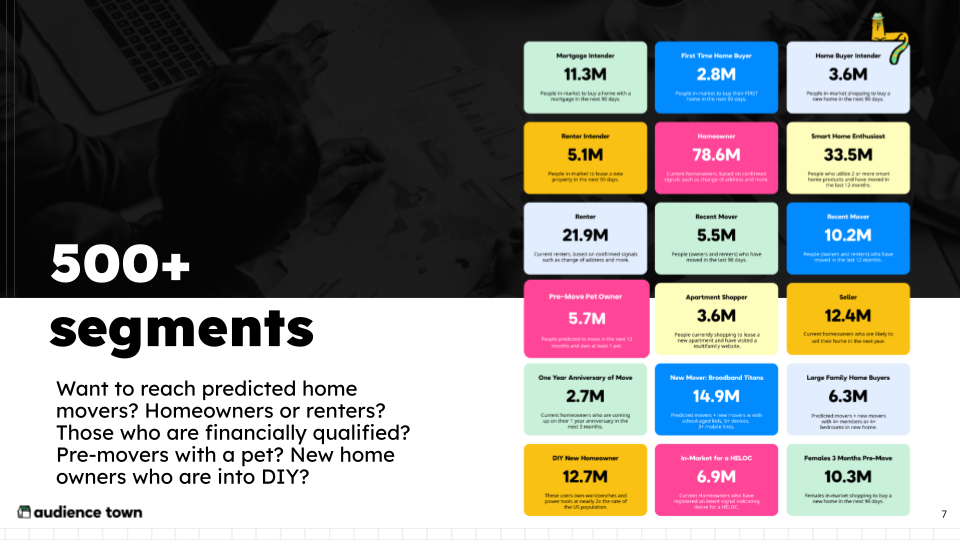
Because the underlying data is observed, deterministic, and probabilistic modeling trained on real Home Journey signals, Audience Town can build segments with a level of specificity that a generic audience platform can't match.
The catalog spans 500+ home mover segments across the full breadth of the Home Journey. Here's a snapshot:
- 11.3M Mortgage Intenders: people in-market to buy a home with a mortgage in the next 90 days
- 2.8M First Time Home Buyers: people in-market to buy their first home in the next 90 days
- 3.6M Home Buyer Intenders: people in-market shopping to buy a new home in the next 90 days
- 5.1M Renter Intenders: people in-market to lease a new property in the next 90 days
- 78.6M Homeowners: current homeowners based on confirmed signals including change of address
- 33.5M Smart Home Enthusiasts: people who use 2 or more smart home products and have moved in the last 12 months
- 21.9M Renters: current renters based on confirmed signals including change of address
- 5.5M Recent Movers (90 days): owners and renters who have moved in the last 90 days
- 10.2M Recent Movers (12 months): owners and renters who have moved in the last 12 months
- 5.7M Pre-Move Pet Owners: people predicted to move in the next 12 months who own at least one pet
- 3.6M Apartment Shoppers: people currently shopping to lease a new apartment
- 12.4M Sellers: current homeowners likely to sell their home in the next year
- 2.7M One Year Anniversary of Move: current homeowners approaching their one-year move anniversary in the next 3 months
- 14.9M New Mover Broadband Titans: predicted movers and new movers with school-aged kids, 5+ devices, and 3+ mobile lines
- 6.3M Large Family Home Buyers: predicted movers and new movers with 4+ household members or 4+ bedrooms in new home
- 12.7M DIY New Homeowners: new homeowners who own workbenches and power tools at nearly 2x the US population rate
- 6.9M In-Market for a HELOC: current homeowners who have registered an intent signal for a home equity line of credit
- 10.3M Females 3 Months Pre-Move: females in-market shopping to buy a new home in the next 90 days
New segments are added continuously and update constantly. Please note that the exact numbers above will vary, depending on when you choose to activate.
Custom audience builds are available on request.
Download the full audience catalog here.
Home Journey Purchase and Advertising Categories
A mover isn't a single-category buyer. Identifying a mover means identifying someone who is simultaneously in market across dozens of product and service categories. Here's the full scope:
Appliances
-
Cooking Stove, Range, Oven
-
Microwave Oven
-
Refrigerator
-
Washer and Dryer
-
Vacuum
-
Air Conditioner
Consumer Electronics
-
Computers
-
TVs
-
Internet, WiFi, and Cable
-
Stereo and Smart Speakers
-
Voice Assistant
-
Smart Home Technology
-
Security Systems and Cameras
-
Mobile Phone and Landline
CPG
-
Cleaning Supplies
-
Groceries
-
Trash Bags
-
Toiletries
-
Infant and Toddler Food
Fitness
-
Exercise Equipment
-
Treadmill
-
Bikes
-
Sports Equipment
Home Furnishings
-
Bedding and Linens
-
Couch
-
Dining Room and Kitchen Furniture
-
Mattress
-
Shelves and Cabinets
-
Lamps and Lighting
-
Infant Furniture
-
Decor, Pictures, and Decorations
-
Window Treatments and Blinds
Home Improvement
-
Bathroom and Kitchen Remodeling
-
HVAC and Plumbing
-
Doors, Windows, and Skylights
-
Solar
-
Fencing
-
Paint
-
Electrical
-
Sprinklers and Hoses
-
Gardening Tools and Flowers
-
Lawn Care
Retail
-
Automotive
-
Apparel
-
Infant and Baby Needs
Finance
-
Mortgage, Loan, and Refinance
- Banking
Financial Services: Compliance-Ready Segments
For financial services brands, audience data isn't just a targeting question. It's a compliance question.
Mortgage lenders, HELOC providers, insurance carriers, and credit card brands operate under fair lending regulations including FHA and FLA guidelines that restrict the use of certain demographic and geographic proxies in ad targeting. Many third-party audience segments don't meet these requirements, which means financial services brands either skip mover targeting entirely or spend months in legal review before activating.
Audience Town's financial services segments are built proxy-free and designed to meet FHA and FLA compliance requirements from the start. There are no income proxies, no demographic inferences, and no geographic redlining risks baked into the segment construction. What's there instead is property data, transaction data, and confirmed life event signals that are both accurate and compliant.
When a campaign activates Audience Town data, it's not reaching a narrowly defined buyer. It's reaching a household during the most expansive purchasing period of their adult life.
Results Across Categories
The proof of data quality is campaign performance. Across verticals, Audience Town customers consistently outperform industry benchmarks.
 Bear Mattress (Bedding)
By targeting families relocating out of high-cost cities into larger suburban homes, Bear Mattress achieved a 13x ROAS and a 10% increase in conversion rate. They replaced off-the-shelf targeting with mover-specific audience data and captured a large, time-sensitive market at the moment of maximum purchase intent.
Sam's Club (Membership Retail)
Sam's Club combined geo-fencing and Audience Town audience data to find new homeowners near targeted locations who weren't already members. New memberships at targeted locations increased by more than 10%.
Guaranteed Rate (Mortgage Lending)
Guaranteed Rate used Audience Town's intelligence to reach qualified customers looking for new home loans or refinancing. Customer acquisition costs for qualified new home and refinance loans decreased by more than 30%, driven by a dramatic increase in application approvals.
Holt Homes (Home Builder)
Holt Homes used audience data to reach potential buyers only once they were ready to look. Click-through rates were 3x higher than the digital media average, and cost per lead decreased by as much as 50%.
Sunrun Solar (Solar Energy)
Sunrun used fresh mover data on Facebook, achieving the highest conversion rate among three audiences tested: 28% higher in month one. By month three, they beat their cost-per-conversion goal by 12%.
Miller and Smith (Homebuilder)
Miller and Smith used audience data to reach potential buyers and renters within a targeted area via premium connected television. Retargeting home movers after streaming TV exposure produced a click-through rate 4x the industry average and a conversion rate increase of nearly 25%.
AMLI (Multifamily Residential)
AMLI used audience data and geo-targeting to reach renters actively searching for a new apartment. Customer acquisition costs for qualified apartment leases decreased by 64%.
Ready to Reach Them?
Home movers are the highest-value, highest-intent audience in consumer advertising. They're in market across categories, open to new brands, and moving through a defined 24-month window that Audience Town maps better than anyone else.
Getting started is straightforward. Audience Town's 500+ segments are available on the LiveRamp Data Marketplace today, with one-click activation across major DSPs including Google DV360, The Trade Desk, and Amazon DSP. Custom audience builds and private data deals are available on request.
If you're not sure which segments fit your category, that's what we're here for. Reach out and we'll build a recommendation based on your vertical, your DSP, and where your customers are in the Home Journey.
Learn more about Audience Town's segments here.
And when you're ready, connect with our data team to learn more about activating these audiences.