Our first State of Home Builder Marketing report ran the Whengine®, the home mover intelligence engine, on 373 million website sessions across 135 home builders over twelve months. (You can download the full report here.)
One traffic source behaved differently from every other channel we measured.
We wrote in March about AI cutting into organic traffic, and that hasn't reversed. AI Overviews answer the question inside the results page, so fewer people click through. But something else is happening alongside it.
When someone asks ChatGPT about new construction in their market, it sends them to a website, and often that website belongs to a home builder.
AI referrals grew twelve times in a year
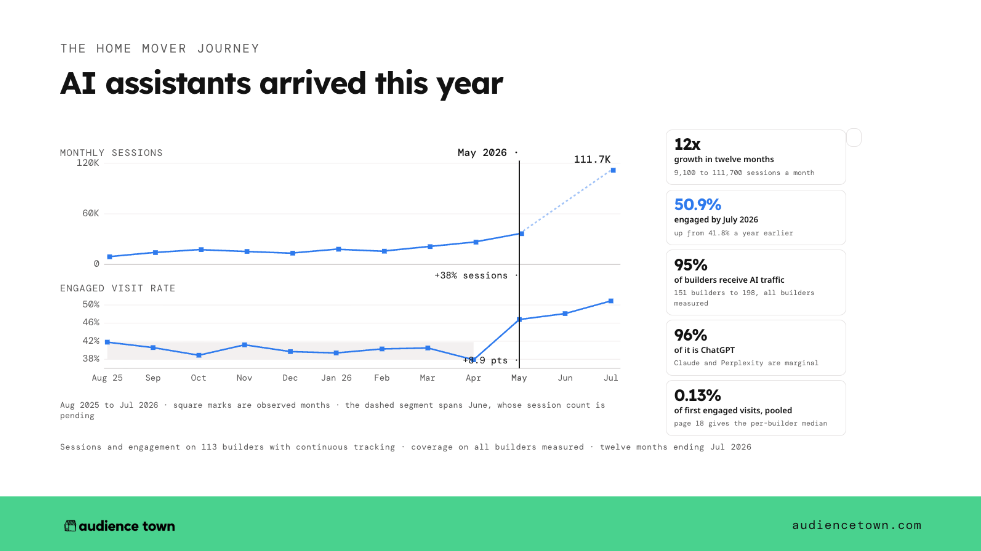
In August 2025, AI assistants sent about 9,100 sessions a month to the builders we measured. In August 2026 it was 111,700. That's twelve times as many in a year, and 95% of builders now get some of it.
About 96% of it comes from ChatGPT, with the rest spread across a handful of other assistants. Google's AI traffic doesn't show up in these numbers, since Google reports AI Overviews and Gemini referrals as organic search or direct traffic and doesn't separate them from regular search.
Engagement rose as the traffic grew
Most channels get bigger or they get better. Volume goes up and quality dilutes, or you tighten targeting and volume falls.
AI did both. While volume grew twelve times, the share of AI-referred sessions that engaged rose from 41.8% to 50.9%, the highest of any channel in August.
We count a visit as engaged if it includes two or more page views, or thirty seconds or more on the site. That bar sounds low, but it screens out more traffic than you'd expect (bots included).
One caveat on the annual numbers. Measured across the full twelve months, AI's median engagement is 33%, below organic search at 45.2%, because the yearly figure blends in the lower months from late 2025.
Four in five land on an interior page
ChatGPT links to specific pages. Roughly four in five AI-referred sessions land on a community page, a floor plan or another interior page instead of the homepage. They also view more pages once they arrive, averaging 2.3 per session against 1.9 for direct traffic.
AI visitors skew affluent
The Whengine connects a site visitor to a household, which is how we can describe the financial profile of the people arriving from each channel.
Twenty-seven percent of households arriving from an AI assistant earn more than $150,000, against 19% to 26% for every other channel. Thirty-four percent own a current home worth more than $500,000.
Keep the sample size in mind. The AI group is about 5,400 households, where other channels run to hundreds of thousands. It may also say more about who's using AI to shop for a home right now than about the channel itself. Early adopters of most technology skew affluent, and that gap may narrow as more people start using it.
Seven in ten go straight to the builder's own site
The tracking parameters on a link tell us where ChatGPT found it. Seven in ten AI-referred sessions arrive on a clean, untagged URL on the builder's own site, so ChatGPT is reading builder pages directly. Another 9% arrive on URLs carrying Google Business Profile or local listing tags, up from almost none in June. The remainder carry tags from a builder's own organic or campaign tracking.
Five things to try this week
AI isn't a major driver of leads or sales today. Paid social brought builders 79.3 million sessions over the year we measured, and AI assistants brought 325,000. It's hard to justify a big budget line for AI visibility yet.
A few tactics are showing promise anyway, and most of them cost nothing.
- Break out ChatGPT referrals in your analytics. ChatGPT adds a source parameter to its outbound links, so the traffic is easy to find if you look for it, and it tells you how much AI matters to your business specifically. Audience Town Analytics breaks it out for you.
- Ask ChatGPT about new construction in your markets. See whether your communities show up, whether the details are right, and whether a competitor appears instead. Try it a few times on different devices and logins, since ChatGPT tailors answers to what it knows about the person asking.
- Keep your local listings current. About 9% of ChatGPT referrals now arrive through Google Business Profile or local listing links. It's early and it could shift, but ChatGPT is clearly reading listing data, and keeping your profiles accurate is free.
- Give reviews their own indexable page. One builder in our panel got roughly 12,000 ChatGPT sessions to a single reviews page over three months. They were the only builder in the sample with a dedicated reviews page, so we can't say whether it was their page or review pages in general. It does suggest people ask ChatGPT about builder reputation.
- Add structured data to community and floor plan pages. Schema markup already helps in organic search, and AI assistants read it too.
The channel is small. It's also growing fast and already reaches 95% of builders, so it's worth an hour this month to see how your communities show up in it.
These findings come from the State of Home Builder Marketing 2026, our first industry report, built on 201,000 closed home sales across 25 markets and 373 million website sessions across 135 home builders.
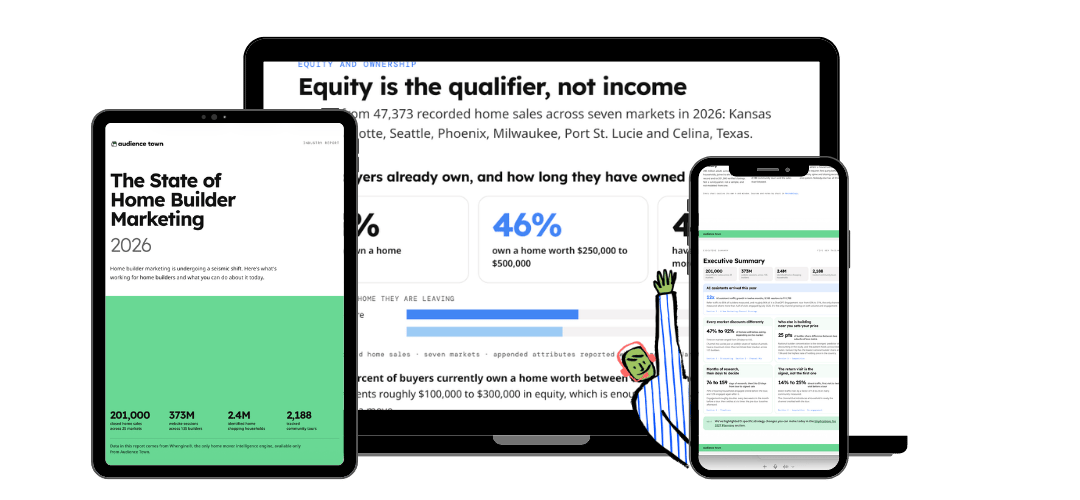
Download the full report for all 25 markets and nine changes to make before 2027 planning closes.