.png?width=250&height=27&name=AT%20-%20LOGO%20-%20BLACK%20-With%20White%20House%20(2).png "audience-town")
.png)
With this year's International Builder's Show in the rearview, it's time to reflect on some of the major themes. Across dozens of education sessions and Sales Central conversations, one word kept surfacing for me: recalibration.
Home builders are under pressure from rising prices, slower sales, and unsold inventory. New AI tools seem to crop up every minute...but are they useful, or just shiny? Open houses are full, but sales cycles are slow. Nothing is obviously broken, but at the same time, nothing is working like it used to. It's time to recalibrate.
It seems to me that home builders have three pathways to respond - and they're not mutually exclusive.
The Three Strategic Paths Home Builders Are Taking to Grow in 2026
1. Invest in brand equity and trust.
This is a timeless, eminently grounded, human-first strategy: invest in building trust. I sat in on two great sessions that proposed different (but aligned) ways of doing this:
- The first, Reimagining the Buyer Journey: Builder Lessons from Fashion, Tech & Hospitality, was led by Sarah Titus of Eastbrook Homes and Genevieve Benson of Milesbrand. They discussed the importance of mapping your marketing and sales to the buyer journey. You're probably doing this, but again...recalibrate. They presented a three-pillar framework for determining if you're actually delivering your buyers a consistent, compelling experience. And my guess is that there's room to improve (there always is).
- The second, Stop the Scroll: Brand Storytelling That Grabs Attention, Inspires Trust & Makes the Sale, featured Homes by Dickerson's Brooke Carroll and Anna Howell, and Do You Convert's Karla Tuten. This session presented new ideas about the role of brand-building in reducing friction throughout the sales process, and showcased Homes by Dickerson's incredible Parade of Style as a case study. Investing in brand articulates their value to customers at every touchpoint, building trust and making it so home buyers want to say "yes."
Both sessions reiterated that even though we may use funnels and flywheels to illustrate the customer journey, that's not actually how most buyers behave today. They're moving in squiggles, loops, and hops. And as Audience Town data shows, they're taking 200+ days from first interaction to final close.
An investment in brand and buyer experience requires commitment, but taking good care of your customers is a tried-and-true strategy. The downside? It's often expensive and can be hard to prove, which brings us to our next pathway:
2. Doubling down on performance and precision.
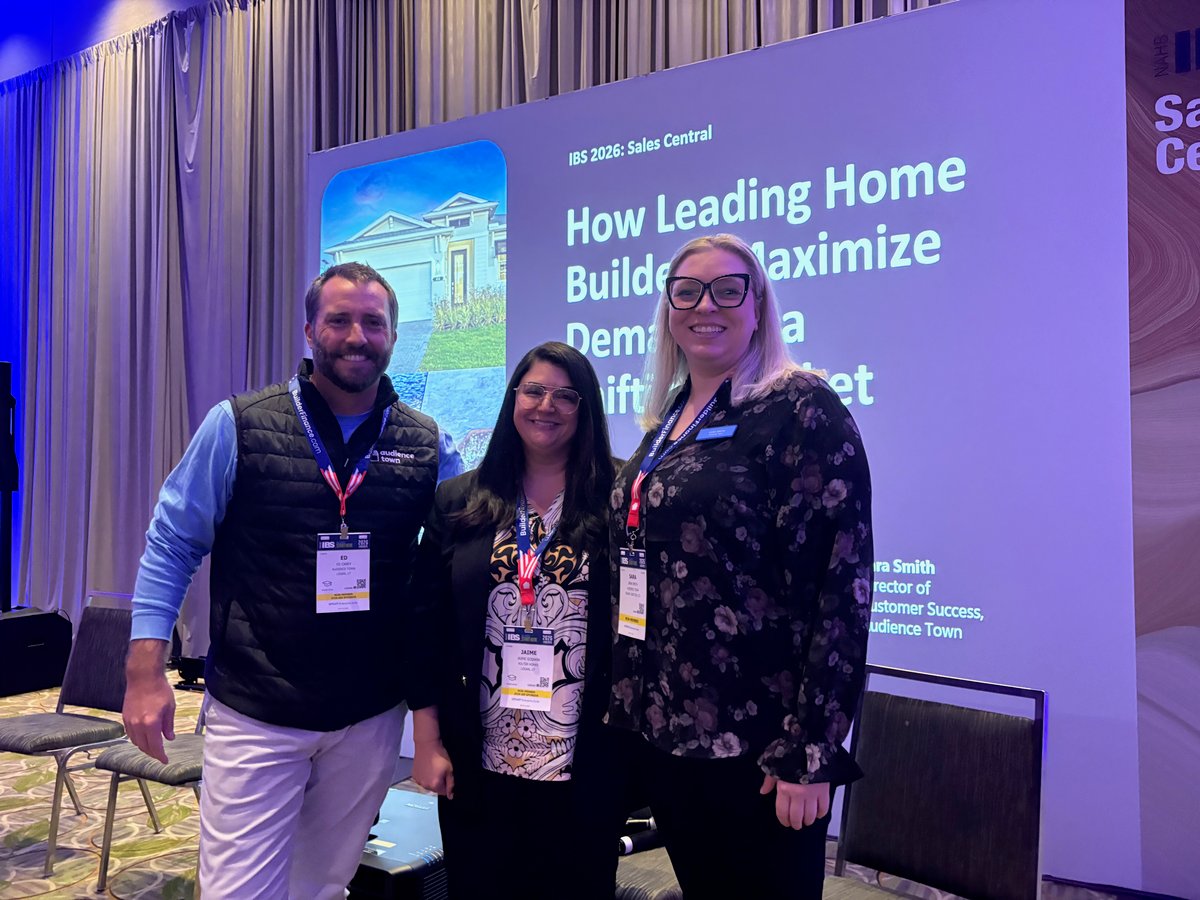
This was a key theme of "How Leading Home Builders Maximize Demand in a Shifting Market." In this session, Audience Town's Ed Carey interviewed Jaime Godwin of Kolter Homes and Sara Smith of Audience Town about strategies for navigating a longer buying journey. They talked about how increasing pressure has driven more precision in their marketing strategy.
One tactical takeaway?
Not all traffic is the same.
Instead of treating website visitors as one pool, they have different lead nurturing strategies for new visitors vs. returning visitors.
The key insight was this:
In a reluctant market, efficiency doesn’t mean cutting activity. It means focusing attention where intent is building.
That’s precision.
It requires recalibrating your strategy. And it requires visibility.
You can’t segment behavior you can’t see. You can’t prioritize returning visitors if your analytics don’t clearly identify them. You can’t tighten retargeting if your data is siloed. That's exactly where Audience Town comes in. Learn more.
Jaime’s approach reinforced something we heard repeatedly at IBS: in 2026, winning teams won’t necessarily focus on generating the most traffic.
They’ll convert better because they understand buyer signals more clearly, and respond accordingly.
And because that journey is longer, Jaime says it's key to put the customer in the driver's seat. "We're shifting from 'When can you come in?' to 'What can we do to help?'" She added, "We let our buyers set the pace, build the picture. This approach lets them make a decision on the quality of life, not just the financial decision."
3. Do more with what you already have.
Almost everyone is asking:
-
How do we get more output from the team we have today?
-
How do we make our current tech stack more effective?
-
How do we convert more of the demand we're already generating?
And this brings us to the other dominant theme, alongside slower buyer journeys: AI.
AI adoption is underway, starting (it seems) with AI sales agents. Melissa Cervin of Lombardo Homes spoke with Anewgo about how they're using AI sales agents to improve speed-to-lead and shopper education. It's a powerful use case, and one that I think we'll see a lot of home builders testing in 2026.
But there's another opportunity that doesn't require new tools. It doesn't require "tightening your belt loops." It's all about recalibrating your relationship to the tools and technology you're using.
It's slightly provocative: instead of replacing your tools, ask how they could be doing more for you.
That's what Audience Town's Ed Carey, Foundation Technology's Luke Groesbeck, Eastbrook Homes' Sarah Titus, and Maronda Homes' Matthew Wilson spoke about. In Frustrated by Your Tech, these four leaders articulated the value of pushing your technology companies to build for you.
The truth is, technology companies depend on customer feedback. Roadmaps are shaped by it. Feature prioritization is influenced by it.
But many home builders don’t actively engage that loop.
Instead, they operate in one of two modes:
- Passive usage (“We’ll use what’s there.”)
- Or quiet frustration (“This isn’t exactly what we need.”)
The real opportunity is in collaboration. In partnership.
As Ed said, "Today, technology companies are your outsourced R&D department. Use us."
Now is not the moment to pull back.
In this era of reluctant buyers, pulling back marketing and sales can be tempting - but it's a mistake, because demand is there.
You need to position yourself to capture it.
And again, that means recalibrating.
-
Recalibrating your understanding of your customers, their needs, and their journey. To do that, you need visibility into what's working and what's not. Enter: Audience Town. It's like professional grade Google Analytics, built on consumer data about your traffic and leads that you can't get anywhere else (like household income and if they have pets).
- Recalibrating your performance strategy to connect with and convert home buyers for the duration of a longer buyer journey.
- Recalibrating your relationships so that you get more of what you want from the tools and tech you already have. From all of us at Audience Town: we welcome your requests, your feedback, your ideas.
And ultimately, recalibrating how and where you show up.
Because precision doesn’t stop at measurement. It extends to activation.
If you know who is in market…
If you understand where intent is forming…
If you can see returning visitors building momentum…
Then the next logical step is this: meet them where they are.
Not just in search results and social feeds. But on their TVs when they're streaming their favorite shows. During their commute to work while they listen to their favorite podcast. On their phone while they're scrolling during their lunch break. And even in their mailboxes with targeted direct mail.
That’s why we’re so excited to formally launch Audience Town’s Advertising Solutions.
For years, we’ve helped select builder and agency partners activate verified, in-market home movers across channels. Now, we’re bringing that capability directly to home builders.
Because in a recalibrated market, broad reach is expensive.
But precision pays off.
The buyers are still there. Will you meet them?
Audience Town can help. Reach out to learn how.